
Cut-Off Wheels on 25 mm Rebar: 49 Cuts, 8 Seconds per Cut (Test Record)
In-house cut-off wheel test: one 180 x 1.6 x 22.23 mm wheel made 49 cuts through 25 mm rebar at 8 s per cut, losing 73 g and wearing from 180 mm to 90 mm. Full conditions and limits.
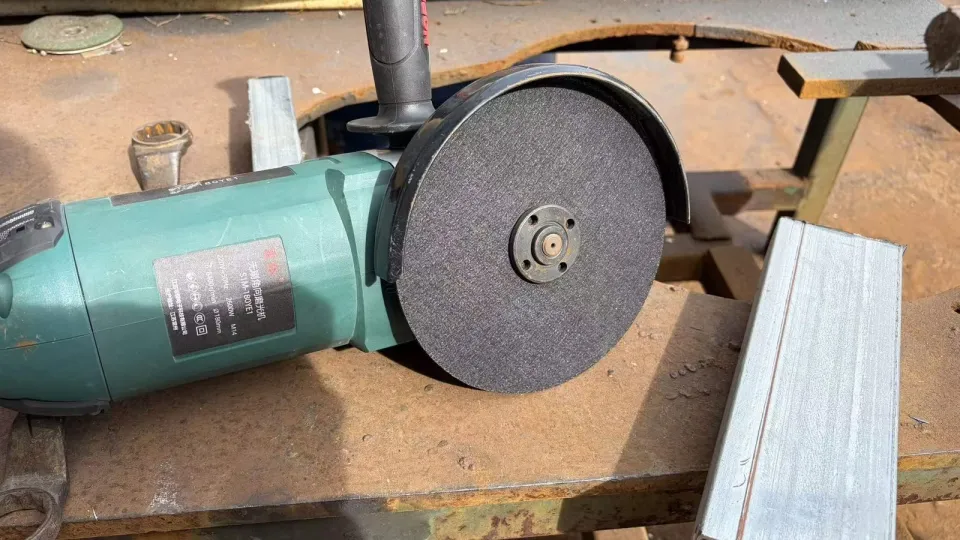
The short answer: On 11 November 2026 we ran one CCWX 180 × 1.6 × 22.23 mm (7 in) resin-bonded cut-off wheel to the end of a recorded test run in our own test room, cutting 25 mm deformed steel reinforcing bar (rebar) freehand with a 2,600 W brushless angle grinder. It completed 49 cuts at an average of 8 seconds per cut, lost 73 g of wheel mass (97 g → 24 g) and wore from 180 mm to 90 mm in diameter. That is one wheel, one operator, one workpiece and one run — a measured record, not a product specification, not a comparison and not a performance guarantee. Below is the complete test sheet, what the numbers mean, what they cannot tell you, and how to run the same check on your own job.
Watch the test video on YouTube: 49 cuts through 25 mm rebar — CCWX 180 × 1.6 × 22.23 mm cut-off wheel.
For anyone buying cut-off wheels, the practical question is never "how hard is the grain?" It is: how many acceptable cuts will I get, how long does each cut take, how often will the operator stop to change a wheel, and what does one finished cut actually cost? Those questions are usually answered with a marketing figure. We prefer to publish the raw sheet. It is slower, but it is the only way a supplier earns the right to recommend a wheel.
1. Why we publish one test sheet at a time
A single test does not prove that a product is good. It proves what happened under one set of conditions, on one date, with one wheel. That is still worth writing down, because cutting performance is highly condition-dependent: workpiece grade and diameter, grinder power and speed, wheel thickness and bond, operator pressure, cutting angle, and whether the cut is guided or freehand all change the result.
Publishing the conditions alongside the result lets a buyer decide whether the test resembles their own work. It also keeps us honest. A claim that jumps from one data point to "industry-leading life" is not a technical statement, and it does not help the person holding the grinder.
This is the third field record we have put in writing. An earlier report covered a CCWX 180 × 6 grinding disc on 45# steel, where three 10-minute rounds showed why material removal and wheel wear must be read together. A second covered 400 × 3.2 × 32 mm resin-bonded cutting wheels on 50 mm alloy steel, where an A formulation and a coated white fused alumina STRWA/A formulation were compared on a stationary machine. Those were grinding and stationary-cutting jobs. This one is a thin, hand-held cut-off wheel on ribbed reinforcing bar — a different and, for a 1.6 mm disc, a less forgiving application.
That is what "one step at a time" means in practice: add a condition, keep the record, publish the limits, and let the next test answer the next question. Over years, a stack of comparable records is far more useful to a customer than one impressive number.
2. The complete test record
The table below is a direct English transcription of our handwritten test sheet. No value has been rounded, interpolated or adjusted.
Recorded item | Value |
|---|---|
Test date | 11 November 2026 |
Brand | CCWX |
Wheel type | Resin-bonded flat cut-off wheel, T41 |
Nominal size | 180 × 1.6 × 22.23 mm (7 × 1/16 × 7/8 in) |
Measured wheel thickness | 1.8 mm (nominal 1.6 mm) |
Abrasive grain | A/WA blend — brown fused alumina and white fused alumina |
Wheel marking | T41-A/F36Q4BF; MAX 8500 rpm; 80 m/s; Metal & Inox |
Wheel mass before test | 97 g |
Workpiece | 25 mm deformed steel reinforcing bar (rebar) |
Test location | Bodan in-house test room |
Complete cuts recorded | 49 |
Average time per cut | 8 s |
Wheel mass after test | 24 g |
Wheel diameter after test | 90 mm |
Cutting method | Manual freehand cutting, hand-held |
Machine | Leilun brushless angle grinder, 2,600 W |
Original notes field | Blank |
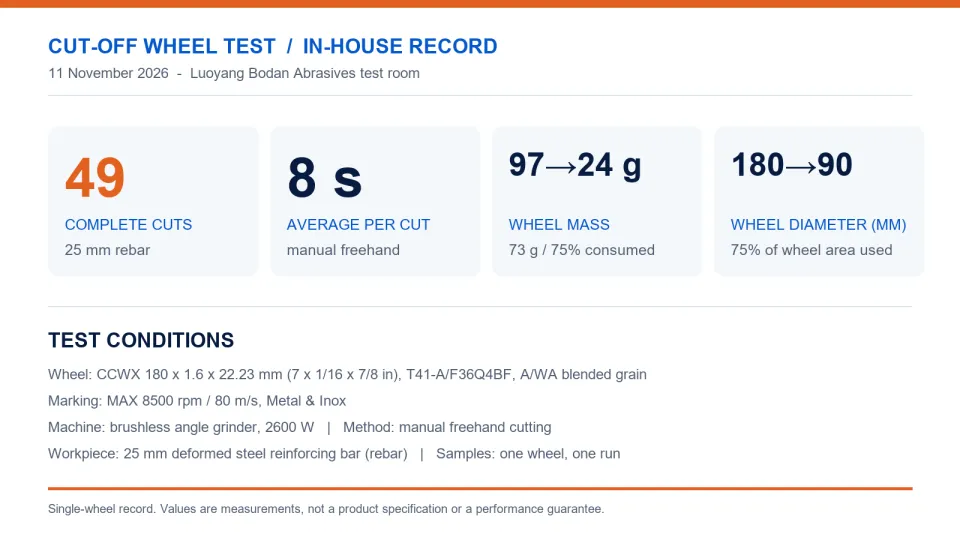
Two details deserve attention before any interpretation. First, the measured thickness was 1.8 mm against a nominal 1.6 mm. We report both because the as-made thickness changes kerf width, cutting resistance and how much consumable material is in the wheel; our earlier field reports record measured thickness for the same reason. Second, this was freehand cutting, not a clamped, guided cut. Operator pressure and wheel alignment were not held as controlled variables, so the 8-second average describes this operator on this day.
3. What the numbers actually say
Simple arithmetic makes the record more useful:
Derived figure | Calculation | Result |
|---|---|---|
Total wheel-on-metal time | 49 cuts × 8 s | 392 s, about 6 min 32 s |
Wheel mass consumed | 97 g − 24 g | 73 g, or 75.3% of starting mass |
Wheel diameter consumed | 180 mm − 90 mm | 90 mm, or 50% of starting diameter |
Wheel area consumed | 1 − (90/180)² | 75.0% of the original disc area |
Average wheel mass per cut | 73 g ÷ 49 | about 1.49 g per cut |
Average diameter loss per cut | 90 mm ÷ 49 | about 1.84 mm per cut |
There is a useful consistency check here. A wheel worn uniformly from 180 mm to 90 mm has lost 75.0% of its disc area, and this wheel lost 75.3% of its mass. The two figures agree closely, which is what you would expect if the wheel wore down evenly around its circumference rather than chipping, breaking or delaminating in one area. It is a sanity check on the record, not proof of wheel quality — but in a first-party test sheet, internal consistency is worth showing.
The 8-second average also has a practical reading. At roughly 6½ minutes of actual cutting time for 49 cuts, an operator on a repetitive rebar job spends far more of the shift positioning work, moving between cuts and changing wheels than actually cutting. That is why "cuts per wheel" alone is an incomplete purchasing metric: cycle time and changeover time belong in the same calculation.
We deliberately stop there. 49 cuts is not a rated life, an average, or a minimum. The record ends at 90 mm because that is where the run was recorded; we did not continue to a smaller diameter, so the usable end point for a given grinder, guard and flange was not established by this test. No second wheel was run, no competing product was tested, and no statistical spread can be calculated from one sample.
4. Reading the label before you choose a cut-off wheel
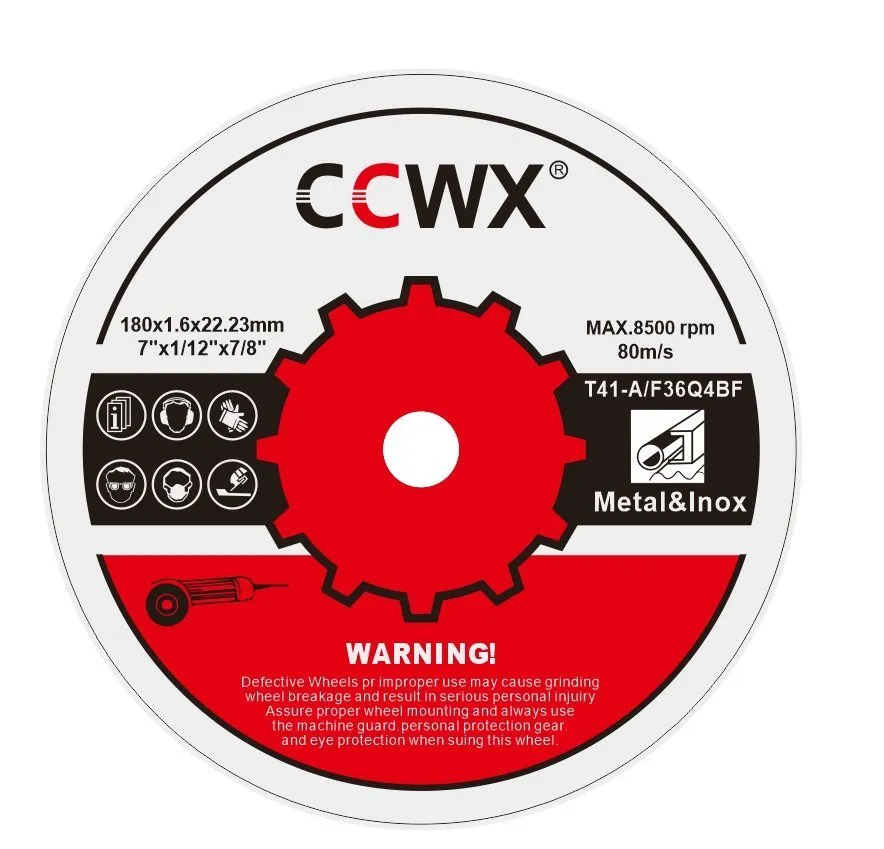
The label carries most of the information a buyer needs, if you know how to read it:
180 × 1.6 × 22.23 mm — outside diameter × thickness × bore. The 22.23 mm (7/8 in) bore fits common 180/230 mm angle grinders. At 1.6 mm this is an ultra-thin metal cutting disc: a narrow kerf, less material removed, lower cutting resistance and less heat input, at the cost of being less tolerant of side loading and wheel binding.
T41 — a flat (non-depressed-centre) Type 41 cut-off wheel. Flat wheels give maximum usable cutting depth; they are for peripheral cutting only, never for grinding with the face or side of the wheel.
A/WA / F36 / Q / BF — an aluminium-oxide abrasive system blending brown fused alumina (A, tough) and white fused alumina (WA, friable and self-sharpening), in a 36-grit, Q-hardness, resin-bonded, fibreglass-reinforced construction. The blend is a common way to balance cut rate against wheel life; the exact ratio is part of the maker's formulation, not something a label can tell you.
MAX 8500 rpm / 80 m/s — the rated maximum. A 180 mm wheel at 8,500 rpm runs at roughly 80 m/s peripheral speed. Match the wheel rating to the machine, never the other way round, and never exceed the 80 m/s limit.
Metal & Inox — marked for carbon steel and stainless steel. For stainless work, use wheels specified as iron-, sulphur- and chlorine-free to avoid contamination and rust marks on the cut face; our Stainless Steel Cutting Disc range exists for exactly that reason.
Safety — fit the correct guard and flanges, check the wheel for damage before mounting, let it run free briefly after mounting, wear eye, face and hand protection, support the workpiece so it cannot pinch the wheel, and keep the wheel in line with the cut. Resin-bonded cut-off wheels supplied into Europe are normally expected to meet EN 12413; confirm the applicable standard and documentation for your market before purchase.
For general carbon steel, structural sections and rebar, our Carbon Steel Cutting Disc range covers 100–400 mm diameters, includes the 180 × 1.6 × 22.2 mm (7 in) size used here, and lists 8,500 rpm / 80 m/s for that size.
5. How to reproduce this test on your own workpiece
A supplier's number is only a starting point. This is the sequence we recommend to customers who want to choose a cut-off wheel on evidence rather than on a datasheet:
Fix the workpiece. Use one batch and one diameter of bar or section. Record the grade; 25 mm deformed rebar, plain carbon bar and alloy steel do not behave the same way.
Fix the machine. Same grinder, same rated power and speed, same guard, flanges and wheel batch. A 2,600 W brushless machine will not reproduce results from a small corded grinder.
Fix the operator and the method. Freehand cutting is the largest source of spread. Use one operator, one stance, one cutting angle and a repeatable feed, or clamp the work and use a guided cut if that is your real process.
Weigh and measure before and after. Wheel mass to 1 g and remaining diameter in mm, as in the record above.
Time every cut, not just the average. Record the spread; a rising time-per-cut near the end of wheel life tells you when a wheel has stopped being productive.
Record cut quality, not only count. Burr height, discolouration or burn on the cut face, squareness, vibration, noise, smell of overheated bond and any wheel breakage.
Repeat at least three wheels from the same batch, and preferably from two batches, before setting an expectation or a purchasing standard.
Calculate cost per acceptable cut. (Wheel price + labour and downtime per change) ÷ number of cuts that meet your quality standard. A cheaper wheel that produces 20 unacceptable cuts is not cheaper.
If you send us your workpiece, machine, monthly volume and what counts as an acceptable cut, our technical team will recommend a starting specification and sample wheels rather than asking you to choose from a size list. That is usually the fastest way to solve a cutting problem.
6. Choosing a cut-off wheel for rebar and structural steel
Your situation | What to look for | Where to start on our site |
|---|---|---|
Thin sheet, small tube, portable work | 100–125 mm ultra-thin wheel, 1.0–1.2 mm, high rpm rating | |
Rebar, sections, medium pipe, hand-held grinder | 150–180 mm, 1.6 mm, A/WA or A grain, 80 m/s rating | Carbon Steel Cutting Disc — the 180 × 1.6 × 22.2 mm size tested here |
Stainless steel / inox, no rust staining allowed | Iron-, sulphur- and chlorine-free formulation, "Inox" marking | |
Heavy sections with a high-power grinder | 230 mm wheel, 2.0 mm or thicker, machine power to match | |
Batch cutting of large bar on a stationary machine | 300–400 mm, 3.0 mm and above, fixed guard and feed | |
Rail or special alloy grades | Application-specific bond and grain, validated on the actual section | |
Metallographic or laboratory sectioning | Fine-grit, cool-cutting wheel, no thermal damage | |
Developing your own wheel formulation | Consistent A, WA or coated WA grain supply |
Two rules cut across the whole table. A thinner cutting disc removes less material and generally cuts faster, but demands better workpiece support and a steadier hand. And a wheel rated for metal is not automatically the right wheel for stainless, cast iron or aluminium — the grain and bond system should match the material.
7. What this test does not tell you
We would rather list the gaps than let a reader over-extend the result:
One wheel, one run, one operator. No repeat samples, no batch spread, no control group and no comparison with another brand or formulation.
Cut quality was not measured. No burr height, cut-face discolouration, burn, squareness, temperature, vibration, noise or breakage rate was recorded. A cut can be fast and still be unacceptable.
No endurance or duty-cycle data. We did not test continuous loading, heat build-up, wheel storage conditions or shelf life.
Only one workpiece. Results on 25 mm rebar say nothing about stainless steel, cast iron, aluminium, alloy bar or larger sections.
No economic conclusion. We have not included wheel price, labour rate or changeover downtime, so no cost-per-cut claim is made.
Not a specification or a warranty. Real results vary with machine condition, wheel batch, material, workpiece support, operator technique and safety practices. Validate on your own workpiece before committing to volume.
8. One step at a time: what we will measure next
Long-term work in abrasives is unglamorous. It consists of repeatable tests, retained samples and records that still make sense two years later. After this run, the next steps in our own programme are concrete:
Repeat the same 25 mm rebar test with three wheels from one batch and then a second batch, and publish the mean and spread, not just the best result.
Hold every other variable constant and compare A, A/WA and coated-WA grain systems in the same 180 × 1.6 mm construction — the same question our earlier stationary-machine record raised.
Add cut-face quality, temperature, vibration and breakage rate to the sheet, so "cuts per wheel" is always paired with "acceptable cuts".
Re-run the test on customer sites with their grinders, their rebar and their operators, and publish the differences rather than hiding them.
Build a simple cost-per-acceptable-cut worksheet that customers can fill in with their own wheel price, labour rate and changeover time.
Keep the dated raw record with every published summary, so any figure we quote can be traced back to a sheet.
This is how we try to be useful to customers: not by promising a universal number, but by narrowing the uncertainty around the one job they actually have to do. A supplier that measures, records and adjusts is a supplier that can help when a batch changes, a new steel grade arrives, or a cutting line suddenly starts consuming wheels twice as fast.
9. Frequently asked questions
How many cuts can a 180 mm cut-off wheel make on 25 mm rebar? In this single in-house run, one CCWX 180 × 1.6 × 22.23 mm wheel made 49 complete cuts at an average of 8 seconds per cut. That is a measured observation under the conditions in section 2, not a rated life or a minimum. Your result will depend on machine, operator, steel grade and what you accept as a finished cut.
Is a 1.6 mm cut-off wheel too thin for rebar? No, thin wheels are commonly used for bar and section work because the narrow kerf reduces cutting resistance and heat. They are less tolerant of side loading, however: keep the wheel square to the cut, support the workpiece so it cannot pinch, use the correct guard and flanges, and never grind with the side of a T41 wheel.
Why was the measured thickness 1.8 mm when the label says 1.6 mm? Manufacturing tolerance and the measuring point both affect the as-made thickness. We publish the measured value as well as the nominal one because it affects kerf width and consumable volume. When comparing wheels, measure thickness yourself rather than assuming the printed figure.
What does T41-A/F36Q4BF mean? T41 is a flat Type 41 cut-off wheel; A denotes an aluminium-oxide abrasive system (here an A/WA blend); F36 is the 36 grit size; Q is the hardness grade; and BF indicates a resin bond with fibreglass reinforcement. Always read the marking together with the rpm and m/s rating on the same label.
Can the same cutting disc be used on stainless steel? The tested wheel is marked Metal & Inox, but for stainless fabrication we recommend a wheel explicitly specified as free of iron, sulphur and chlorine contamination, so the cut face does not develop rust marks. See our Stainless Steel Cutting Disc range.
Why did the test stop at 90 mm? The original record ends at 90 mm remaining diameter; we did not continue the run beyond that point. The smallest usable diameter depends on the grinder's flange, guard, required cutting depth and the wheel maker's instructions — none of which was established by this test.
How do I compare two cut-off wheels fairly? Keep workpiece, machine, operator, wheel batch, cutting method and acceptance criteria identical, run at least three wheels of each type, and record cuts, time per cut, mass and diameter loss, cut quality and breakage. Then compare cost per acceptable cut.
Can I get samples or the raw test record? Yes. Contact our export team with your workpiece, grinder model, monthly volume and quality criteria, and we will recommend a starting specification, arrange sample cut-off wheels and share the relevant test documentation.
10. Conclusion
One CCWX 180 × 1.6 × 22.23 mm cut-off wheel, one 2,600 W brushless angle grinder, 25 mm rebar, freehand: 49 cuts, 8 seconds per cut, 73 g of wheel consumed, 180 mm down to 90 mm. The mass loss and the area loss agree at about 75%, which makes the record internally consistent; the single sample and the missing cut-quality data are exactly why we do not turn it into a product promise.
If you are selecting cut-off wheels for rebar, structural steel or stainless work, start from your own conditions rather than a headline number. Our Carbon Steel Cutting Disc and Stainless Steel Cutting Disc ranges cover 100–400 mm hand-held and stationary applications; the two earlier field test records on grinding and stationary cutting show the same method applied to other jobs. Send us your workpiece and machine details for samples, a recommended specification and a trial plan — we will work through it one step at a time.