
Grinding Wheel Markings & Selection Guide
How to read a grinding wheel code such as WA46K5V1A and 355x38x127, what grain, grit, grade, structure and bond mean, plus a practical selection matrix.
**Source: 内容转自 融马砂轮官网 / reproduced from the RIHON (Rongma) grinding wheel official website** (https://www.craabrasives.com/news/34.html, originally published 2026-03-17). Compiled, translated and re-formatted by Luoyang Bodan Abrasives Co., Ltd. for selection and enquiry reference only. Final specifications are subject to the technical documents agreed by both parties.
Why this guide:A grinding wheel specification looks cryptic at first glance — WA 46 K 5 V 1 A, 355 x 38 x 127. In practice every character tells the supplier something they need in order to make the right wheel. This guide puts those codes into a readable order, explains what a wheel is made of, and summarises how grain, grit, grade, structure and bond are chosen for a given job.
1. How a Grinding Wheel Cuts
A grinding wheel works by rotating at high speed so that millions of hard, sharp, heat-resistant abrasive grains on its outer surface continuously cut tiny chips from the workpiece. As grains wear, they fracture or are released to expose fresh sharp cutting edges, while the pores between grains provide chip clearance. This self-sharpening action is what lets one wheel keep cutting across a wide range of materials.
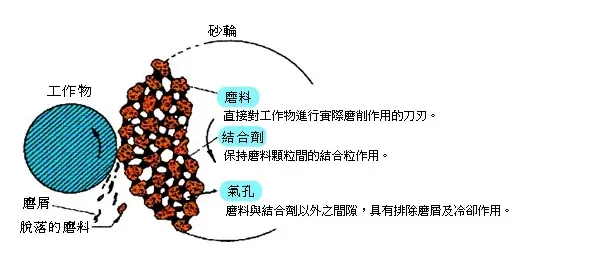
Schematic: abrasive grains cutting the workpiece surface during wheel rotation
2. The Three Elements of a Wheel
A bonded grinding wheel is built from three elements: abrasive grain, bond material and pores (air spaces). The grain does the cutting; the bond holds the grain until it is dull; the pores provide chip space and cooling. Changing the proportion and spacing of these three is exactly what the grade and structure numbers in a wheel marking describe.
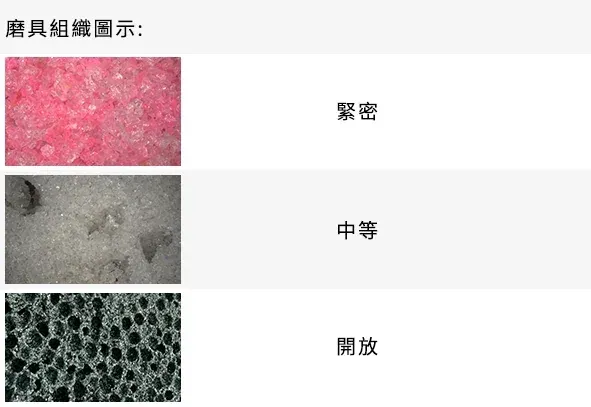
Structure: dense, medium and open grain spacing
A dense (low-number) structure suits hard, brittle materials and precision finishing; an open (high-number) structure gives more chip clearance for soft, ductile or gummy materials and heavy stock removal.
3. Reading a Wheel Marking
A typical marking reads: WA 46 K 5 V 1 A, with dimensions 355 x 38 x 127 mm. The letters and numbers follow a fixed order — abrasive, grit, grade, structure, bond, shape, edge profile. The dimensions are always outer diameter x thickness x bore diameter, in millimetres.
3.1 Code-by-code example
Position | Code | Meaning | In the example |
|---|---|---|---|
1 | WA | Abrasive grain | White aluminium oxide |
2 | 46 | Grit size | Medium grit |
3 | K | Grade (bond hardness) | Medium grade |
4 | 5 | Structure (porosity) | Medium structure |
5 | V | Bond type | Vitrified (ceramic) bond |
6 | 1 | Wheel shape | Type 1, straight / flat wheel |
7 | A | Edge profile | Profile A |
Size | 355 x 38 x 127 | Dimensions in mm | OD 355 x thickness 38 x bore 127 mm |
3.2 Abrasive grain codes and colours
The original reference lists the following grain codes with their colour markings. Colour is a maker's identification mark, not a performance grade — always confirm the grain type on the wheel label or order sheet.
Grain code | Colour in source |
|---|---|
A | Grey-black |
38A | Orange-red |
PA | Light pink |
RA | Purple-red |
GC | Light green |
WA | White |
AA | White |
32A | Grey-white |
CRA | Light blue |
C | Black |
19A | Brown |
64A | Grey |
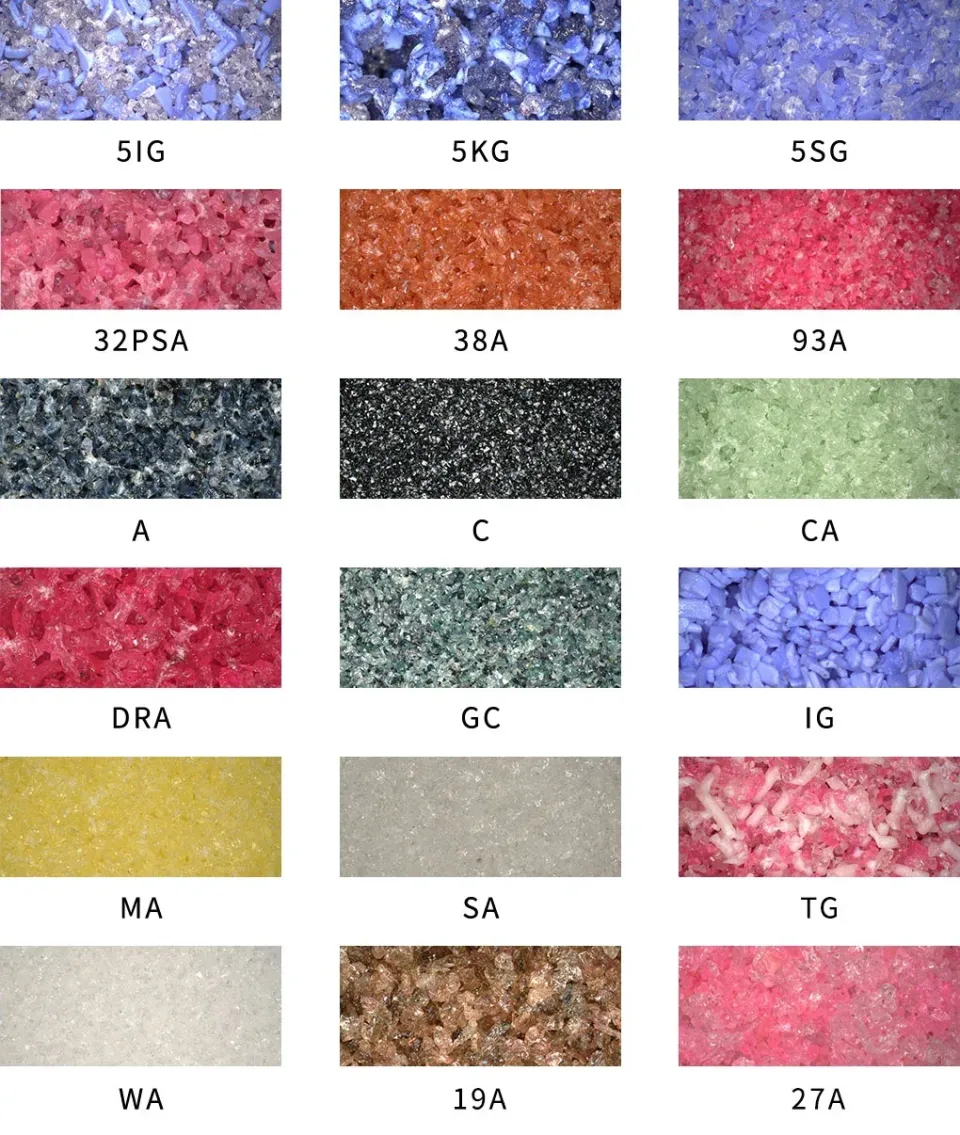
Colour reference for common abrasive grain types
Special and blended grains mentioned in the source include 5IG, 5KG, 5SG, 32PSA, 38A, 93A, A, C, CA, DRA, GC, IG, MA, SA, TG, WA, 19A and 27A; CRA denotes a ceramic aluminium oxide grain. Mixed and special grains are usually selected when higher metal-removal rates or longer wheel life are required.
3.3 Grit, grade, structure and bond ranges
Item | Range in source | Selection logic |
|---|---|---|
Grit size | 16, 20, 24, 36, 46, 60, 100, 120, 150, 180, 220, 240, 280, 320, 400, 500, 600, 800, 1000, 1200, 1500, 2000, 2500, 3000, 4000 (coarse to fine) | Coarse for soft/ductile materials and heavy stock removal; fine for hard/brittle materials and fine finishing |
Grade (bond hardness) | E to U (soft to hard) | Grade describes how firmly the bond holds the grain — not the hardness of the grain itself. Soft workpieces take harder grades; hard workpieces take softer grades |
Structure (porosity) | 0-14, 16, 20-26, 50, 60 (dense to open) | Low numbers are dense, high numbers are open. Soft, gummy work needs an open structure; hard, brittle work needs a dense one |
Bond / process | V vitrified, B resin, R rubber, OM magnesium oxychloride, PVA elastic resin, M (low-speed vitrified process in the source) | V for rough and medium finishing; B/R for fine finishing and high wheel speeds; B for heavy-duty and free-hand grinding |
The source uses M for a low-speed vitrified process (below 2,000 m/min) in its selection table while listing OM for magnesium oxychloride in the marking table. Treat this as a source notation and confirm the exact bond code with the wheel supplier before ordering.
3.4 Standard shapes and edge profiles
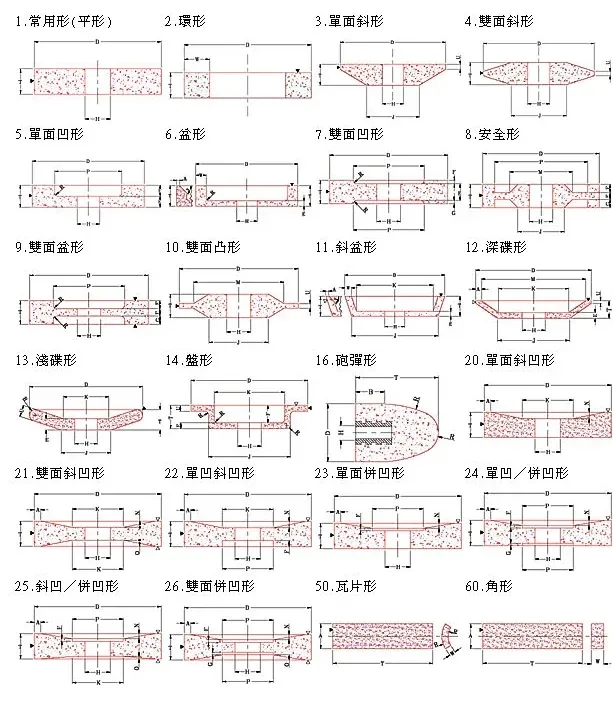
Shape codes in the source run from 1 to 26, plus 50 (tile/segment) and 60 (angle). Edge profiles are lettered A through P. Both are illustrated below.
Standard grinding wheel shapes, type 1 to 26 plus 50 and 60
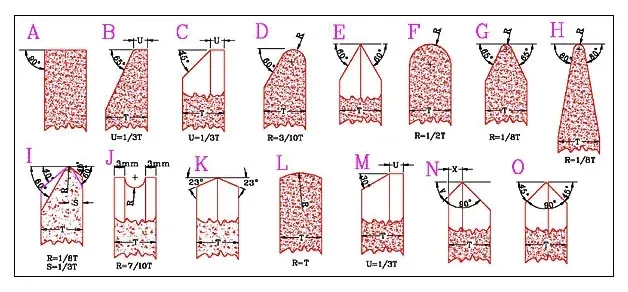
Standard edge profiles A to O with their dimensional notes
4. Other Shape Codes
4.1 Other wheel forms
Form | Marking |
|---|---|
Bullet / projectile wheel | SUED |
Grinding stone (mill stone), general / special | MIL / MSP |
Valve seat wheel | VLVST |
Special irregular shapes | SP |
Disc, 255 x 50 x 50 | O |
Ingot / saddle shape | S |
Type A | A |
Horseshoe shape | H |
4.2 Mounted wheel (with shank) groups
Group | Description |
|---|---|
A Group | Irregular shapes |
B Group | Irregular shapes with small OD (3/4 in and under) |
W Group | All straight mounted wheels |
AJ Group | Extension of A Group |
BJ Group | Extension of B Group |
Others | SF, K, L Group and special-size mounted wheels |
4.3 Honing and dressing sticks
Cross-section | Marking |
|---|---|
Square | SQ |
Rectangular | RT |
Round | RD |
Semi-round | HR |
Equilateral triangle | TR |
With radius (R) | HN |
Irregular | ST |
5. How to Select the Right Wheel
The source separates grinding conditions into fixed conditions (set by the workpiece and the job) and variable conditions (set by the machine and the operator). Each condition points to a preferred grain, grit, grade, structure or bond. The original matrix has been re-arranged here into one rule per row so it can be read and quoted directly.
5.1 Fixed grinding conditions
Condition | Selection item | Rule |
|---|---|---|
Workpiece material | Abrasive | Tensile strength >= 30 kg/mm2 (semi-steel, mild steel): A |
Workpiece material | Abrasive | Tensile strength >= 50 kg/mm2 (hardened steel): WA |
Workpiece material | Abrasive | Hard, difficult-to-grind alloy steel: DA, RA, DR, 32A |
Workpiece material | Abrasive | Tensile strength <= 20 kg/mm2 (cast iron, non-ferrous, non-metal): C |
Workpiece material | Abrasive | Cemented carbide, gemstones: GC; mirror finishing: GC |
Workpiece material | Grit | Soft, ductile material: coarse grit; hard, brittle material: fine grit |
Workpiece material | Grade | Soft workpiece: hard grade; hard workpiece: soft grade; very soft copper/zinc/iron: soft grade |
Workpiece material | Structure | Soft, gummy workpiece: open structure; hard, brittle workpiece: dense structure |
Stock allowance / finish | Abrasive | Heavy duty or heavy free-hand grinding: A, AZ |
Stock allowance / finish | Grit | Efficiency first, large allowance: coarse #10-30 |
Stock allowance / finish | Grit | High removal rate plus good finish: mixed grit #24 / #30 |
Stock allowance / finish | Grit | Small allowance, precision finish: fine grit |
Stock allowance / finish | Grade | Hand grinding and rough grinding: hard grade; precision grinding: medium or soft grade |
Stock allowance / finish | Structure | Costly rough grinding: open structure; precision finishing: dense structure |
Stock allowance / finish | Bond | Rough and medium finishing: vitrified (V); fine finishing: resin (B) or rubber (R); heavy duty: resin (B) |
Contact area | Grit | Small contact area: fine grit; large contact area: coarse grit |
Contact area | Grade | Small contact area: hard grade; large contact area: soft grade |
Contact area | Structure | Small contact area: dense structure; large contact area: open structure |
5.2 Variable grinding conditions
Condition | Selection item | Rule |
|---|---|---|
Wheel peripheral speed | Grade | High speed: soft grade; low speed: hard grade |
Wheel peripheral speed | Bond | Below 2,000 m/min: vitrified process (M in source); above 2,000 m/min: resin (B) |
Workpiece speed | Grade | High speed: hard grade; low speed: soft grade |
Infeed / grinding pressure | Grade | Large infeed: hard grade; small infeed: soft grade |
Infeed / grinding pressure | Bond | Very large infeed and high pressure: resin (B) |
Machine condition | Grade | Good rigidity, little vibration: soft grade; heavy vibration: hard grade |
Machine condition | Bond | Resin-bonded wheels often perform well on machines with heavy vibration |
Grinding fluid | Grade | Wet grinding: one grade harder than dry; dry grinding: one grade softer than wet |
Operator skill | Grade | Skilled operator: soft grade; less experienced operator: hard grade |
6. What to Supply When Ordering
The source opens by asking buyers to supply complete data so the wheel can be manufactured correctly. Bodan has arranged that requirement into the following checklist; it also doubles as a quick way to quote a wheel accurately and avoid a specification mismatch.
Full marking: abrasive, grit, grade, structure, bond, shape, edge profile
Dimensions: outer diameter x thickness x bore (mm), plus any tolerance requirement
Workpiece: material, hardness / tensile strength, and stock allowance
Operation: roughing, precision grinding or finishing; required surface finish
Machine: type, spindle speed / wheel peripheral speed, infeed and contact area
Conditions: wet or dry, grinding fluid, vibration and rigidity of the machine
Quantity, delivery date, packaging and any special marking or labelling
7. Frequently Asked Questions
Question | Answer |
|---|---|
What does WA46K5V1A mean on a grinding wheel? | WA = white aluminium oxide grain; 46 = medium grit; K = medium grade (bond hardness); 5 = medium structure; V = vitrified bond; 1 = straight wheel shape; A = edge profile A. |
Is the 'grade' of a wheel the hardness of the abrasive grain? | No. Grade (E to U) describes how firmly the bond holds the grain. A hard grade means the bond retains dull grains longer, not that the grain itself is harder. |
Why use a hard grade on a soft workpiece? | On soft materials the grains stay sharp longer, so a harder bond holds them without glazing. On hard materials a softer bond lets dull grains shed and exposes fresh cutting edges. |
Does a larger structure number mean a denser wheel? | No. Low structure numbers are dense; high numbers are open with more pore space for chips, which suits soft, gummy materials and heavy stock removal. |
Which bond should be used above 2,000 m/min wheel speed? | The source recommends resin bond (B) above 2,000 m/min and a vitrified process below that speed; always verify the maximum operating speed marked on the wheel. |
Safety reminder: never exceed the maximum operating speed marked on the wheel. Check the wheel for cracks before mounting, use the correct flanges and guards, and follow the machine builder's instructions.
内容转自 融马砂轮官网 — 原文:https://www.craabrasives.com/news/34.html(2026-03-17)。博丹整理转载,仅作技术参考;如需转载原文请与原作者联系。