
What Is Brown Fused Alumina Micro Powder?
Brown fused alumina micro powder is a fine-grit abrasive made by melting bauxite, cooling it into blocks, then crushing, milling, wet-classifying and magnetically treating it to a controlled sub-53 μm range—hard, tough and cost-effective.
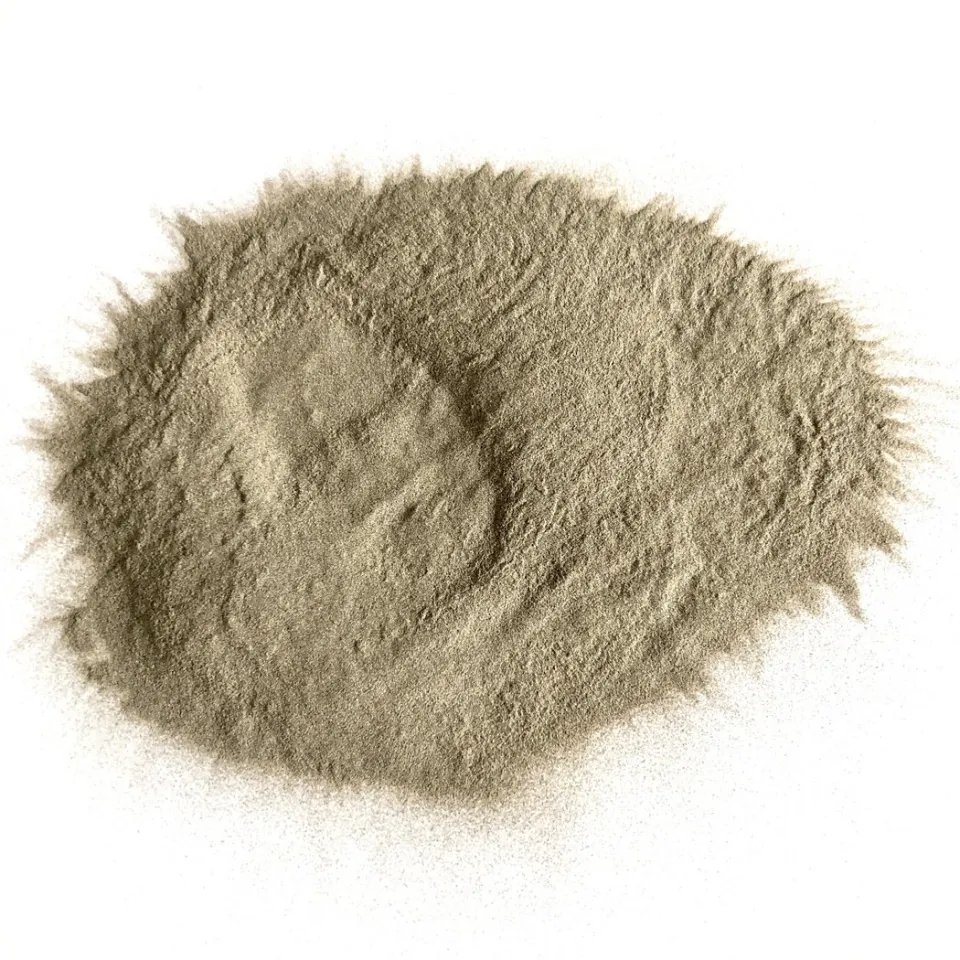
In one sentence: Brown fused alumina micro powder is a fine-grit abrasive produced by melting bauxite in an electric arc furnace, cooling the melt into crystalline blocks, then crushing, milling, wet-classifying (primarily by overflow classification), and magnetically treating the result to a controlled sub-53 μm particle size range. It combines high hardness, good toughness, and competitive pricing—making it a workhorse material for precision grinding, polishing, and high-performance refractories.
1. From "Brown Fused Alumina" to "Micro Powder": The Processing Chain
The starting point is brown fused alumina (BFA) itself. Bauxite, coke, and iron borings are charged into an electric arc furnace and melted at temperatures above 2,200°C. After controlled cooling, the melt solidifies into brown crystalline corundum blocks. These blocks are crushed, magnetically separated, and screened to produce macrogrits (the F4–F220 range).
Micro powder is what happens next. Selected macrogrit feed is milled further—typically in ball mills or jet mills—and then wet-classified to isolate particles within tightly defined micron-scale bands. Within wet classification, overflow classification is the mainstream method in the industry today: an upward water flow is controlled to carry out particles of progressively finer settling velocities, enabling continuous operation, high classification precision, and good batch-to-batch consistency. Sedimentation classification, by contrast, consumes less water but runs only in batches at lower efficiency, and has largely given way to overflow methods. The choice and precision of classification is a background worth keeping in mind when comparing F-designations against measured distribution data later in this article.
Put simply: macrogrits are built to remove material fast; micro powders are built to finish fine and polish bright. They share the same origin, but the processing depth and quality-control demands are entirely different.
2. The Numbers That Matter: F-Designation and Chemical Purity
For overseas buyers, an "F360" or "F800" label is not a single particle size—it is a distribution band. Under FEPA 42-2, F360 requires a median diameter (D50) between 21.3 and 24.3 μm, a coarse-end D3 no larger than 40 μm, and a fine-end D94 no smaller than 12 μm. Two suppliers can both ship "F360" and still deliver materials that behave differently on the line, depending on where their measured distributions sit within that band and how tightly they hold them batch to batch.
Chemically, BFA micro powder's Al₂O₃ content typically falls in the 90%–92% range in practice (with some high-purity or specialty grades running higher), alongside impurities such as TiO₂, SiO₂, and Fe₂O₃. That is markedly lower purity than white fused alumina (usually above 99% Al₂O₃), but the trade-off favors toughness and cost. For most industrial grinding and polishing operations, the performance difference does not justify the price premium of higher-purity alternatives. Buyers should distinguish between "nominal" and "measured per lot" values—different ore sources and melting practices can shift Al₂O₃ content by several percentage points.

Typical Property | Value |
|---|---|
Al₂O₃ content | 90%–92% (typical measured range) |
Mohs hardness | 9.0 |
Microhardness | 1,800–2,200 kg/mm² |
Melting point | ~2,050°C |
Standard microgrit range | F230–F1200 (finer on request) |
3. Where It Actually Gets Used
The application range is broader than many buyers initially expect.
Grinding and polishing is the core use. From stainless steel and aluminum finishing to glass, stone, and semiconductor wafer intermediate steps, BFA micro powder's angular, sharp-edged particle shape delivers efficient cutting without the excessive scratching risk of harder but more brittle abrasives. In blasting, it is a common substitute for silica sand with a lower dust hazard profile.
Bonded and coated abrasives represent the second major outlet. Resin-bonded wheels, sandpaper, abrasive cloth, and polishing compounds all consume microgrit BFA as a primary or blend component.
Refractories and ceramics absorb significant volume as well. BFA micro powder functions as a fine matrix component in high-performance castables and pre-cast shapes, improving density and erosion resistance. Wear-resistant flooring, ceramic filtration membranes, and coating fillers are additional stable demand segments.
4. Why Choose BFA Micro Powder Over Alternatives
If the only requirement is "fine," white fused alumina can deliver. If maximum hardness is the sole criterion, silicon carbide wins in some applications. BFA micro powder's advantage is balance: hardness sufficient for the vast majority of metals and non-metals, toughness superior to white alumina (reducing deep scratch risk from fractured grains), and a price point that makes it viable for high-volume, multi-application use.
The caveat is consistency. A batch labeled F600 with a drifting D50 will undermine the repeatability of any polishing process, no matter how good the specification looks on paper. That is why serious suppliers provide measured D3/D50/D94 values per lot—not just a grit number on the bag.
5. Three Things to Check When Buying
First, confirm the standard. FEPA (European) and JIS (Japanese) grit designations do not map perfectly to one another. The same "fine" label can correspond to different actual particle sizes under different systems. Require the standard reference on the certificate.
Second, request measured distribution data. The F-number is the entry ticket. Where the D50 actually lands, and how wide the spread runs, determines performance. For precision polishing, agree on a tightened internal window within the standard band.
Third, check magnetic content. Residual magnetic material in BFA micro powder can contaminate work surfaces, particularly in electronics and precision component processing. It is worth specifying an upper limit if your application is sensitive.
Bottom line
Brown fused alumina micro powder is not a mystery material—it is a standard industrial product with a well-defined processing route, measurable specifications, and a clear performance envelope. Understanding where it comes from, what the numbers mean, and where it fits (and does not fit) turns the F-designation from a vague code into a technical language you can actually specify and verify.